Opening Prayer
Almighty God, Creator of the wind and the waves, and Architect of our salvation, I humble myself before Your throne this day. I ask that You would send Your Holy Spirit to sweep through this place like a rushing, mighty wind. Shake the foundations of my complacency. Strip away the veneers of my self-righteousness. I do not come today for a comfortable word, but for a true word. Open my ears to hear the thunder of Your justice and my heart to feel the warmth of Your mercy. May the words of my mouth and the meditations of my heart be acceptable in Your sight, O Lord, my Rock and my Redeemer. Amen.
The Collision at Golgotha
We often sanitise the crucifixion. We turn it into polished gold jewellery or smooth wooden icons. But on that Friday, two thousand years ago, there was nothing smooth or polished about it. It was the site of a cosmic cataclysm. It was the moment when the greatest storm in the history of the universe met the unyielding wood of the Cross at Golgotha1.
There is a place where the sky turned black at noon. There is a moment in history where the tectonic plates of heaven and hell ground against one another until the earth itself began to push up its dead – Nations trembled. Hearts fractured. Sin whispered. Death boasted.
Imagine the scene: The air is thick, heavy with the scent of dust and impending rain. The city of Jerusalem is a hive of nervous energy, but out on the Hill of the Skull, the atmosphere is suffocating. For three hours, a supernatural darkness has descended – not an eclipse, but a divine shroud. In Matthew 27:45 it is written “Now from the sixth hour there was darkness over all the land until the ninth hour.”
The mocking laughter of the Roman soldiers has died down into a nervous murmur. The religious leaders, who just an hour ago were spitting insults, are now looking over their shoulders at the horizon.
Then – The storm breaks
It is not just a storm of wind and water. It is the storm of God’s holy indignation against sin. It is the storm of every lie ever told, every blood-spill, every betrayal, and every ounce of human rebellion gathered into a single, localised hurricane of judgment. And at the centre of that hurricane stands a man – beaten, bloodied, pierced, and nailed to a tree.
Matthew 27 tells us that “the earth shook, the rocks split, and the tombs broke open.” This was the collision. The storm of death demanded a victim, and the Cross stood as the lightning rod of eternity. Every bolt of divine justice that should have levelled us was instead diverted into the body of the Son of God. He did not hide from the storm. He did not rebuke the storm as He had on the Sea of Galilee. This time, He opened His arms wide and invited the storm to do its worst to Him, so that it would never have to do its worst to us.
† This was no ordinary death.
† This was no tragic accident of history.
† This was the Lamb standing silent before the storm.
Upon that cross stood the fulfilment of ancient prophecy: “He was pierced for our transgressions; He was crushed for our iniquities2; the punishment that brought us peace was upon Him, and by His wounds we are healed.” (Isaiah 53:5)
Look at Him. Arms stretched wide – not in surrender to Rome, but in surrender to the will of the Father. As He had prayed in the garden3, “Not My will, but Yours, be done.” (Luke 22:42)
The Storm of Judgment and the Anchor of Grace
We live in a culture that is terrified of storms. We spend our lives building financial security, walls of reputation, and shelters of self-care to keep the chaos at bay. But the message of the Cross is a challenging one: You cannot outrun the storm of your own brokenness. You cannot build a wall high enough to keep out the reality of sin and the inevitability of judgment.
The weight of sin – not His but yours, mine, the hidden and the blatant – pressed upon His shoulders, for us. And from the cross He cried out – “My God, My God, why have You forsaken Me?” (Matthew 27:46)
Not because hope had failed. But because He was entering fully into the abyss4 we created. For it is written: “The Lord has laid on Him the iniquity of us all.” (Isaiah 53:6)
The storm that met the Cross was the “perfect storm.” It was the convergence of human cruelty and divine necessity. When we look at the Cross, we see what our sin actually costs. It costs the very breath of God. It costs the silence of the Father. It costs a physical and spiritual agony that causes the sun to hide its face in shame.
If the Cross is anything, it is an end to our illusions of safety. It tells us that the world is a violent, broken place, and that we are, by nature, children of the storm. But – and here is the dramatic pivot of our faith – the Cross is also the only place where the storm is finally stilled.
When Jesus cried out, ”Tetelestai!” – “It is finished” – He wasn’t just announcing the end of His life. He was announcing the exhaustion of the storm. He took the full force of the gale until there was nothing left but the silence of victory.
Hear the prophetic whisper that shakes the heavens: “It is finished5.” (John 19:30)
Not “I am finished.” But it – the debt, the curse, the separation – is finished. For as it is written in Epistle to the Colossians 2:14, “He canceled the record of debt that stood against us… nailing it to the cross.”
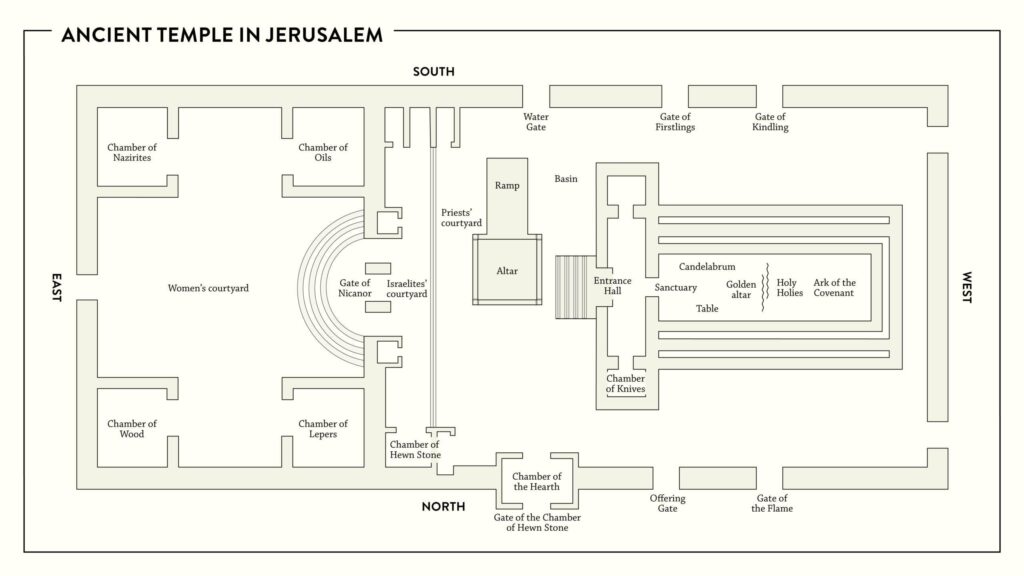
”And the curtain6 of the temple was torn in two, from top to bottom” (Matthew 27:51). But why is this important. It’s important because God was doing something that is easily missed. The veil in the Temple in Jerusalem separated the Holy of Holies – the most sacred space – from the rest of the temple. It symbolised the barrier that had existed between God’s Holiness and humanity’s sin. Once a year, on the Day of Atonement, only the high priest would enter that space.
The tearing of the veil is often understood to mean that, through Jesus’ death, people no longer needed a priest or temple system to approach God. We now had a direct relationship with God, because the barrier between God and humanity was removed. This idea is echoed later in Epistle to the Hebrews (especially chapters 9–10), which explains Jesus as the ultimate high priest.
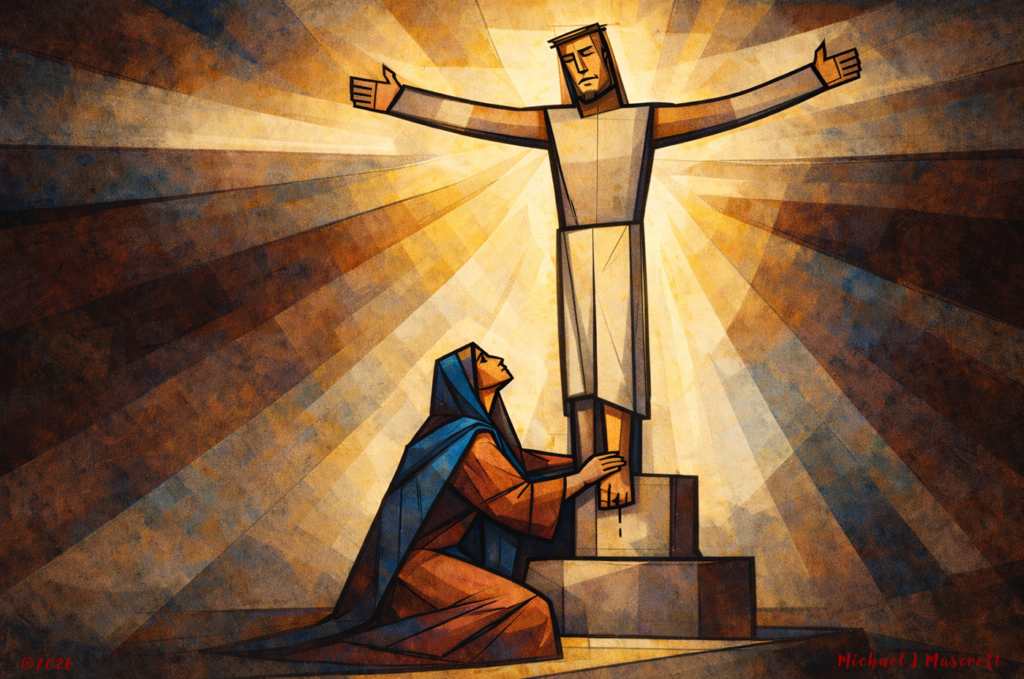
Now let us turn our thoughts to another at the foot of the cross – one who shared deeply in this moment. Mary, pierced with grief. There was no braver woman than the mother of Jesus Christ. On that day, she too lost her son; her heart was torn, much like the curtain in the temple was torn in two (Matthew 27:51).
Yet long before this moment, it had been foretold that her suffering would come. As the old man Simeon had prophesied, “a sword will pierce your own soul too” (Gospel of Luke 2:35). And so it was, as she stood near the cross, witnessing the suffering of her son (Gospel of John 19:25).
Still, she did not turn in anger against God. She did not cry out in bitterness. Instead, with quiet strength and deep humility, she endured. This was the same faith she had shown from the beginning, when she first accepted God’s call: “I am the Lord’s servant… may your word to me be fulfilled.” (Gospel of Luke 1:38)
Mary understood, in a way few could, that this was not a senseless loss. The death of her son was not collateral damage, but part of God’s redeeming purpose. As Scripture later affirms, Christ was given for us all (Epistle to the Romans 8:32), and through His sacrifice, many would be brought back to God (First Epistle of Peter 3:18).
So she knelt at the cross, her tears mixing in the blood of her son – grieving, yet faithful. Broken, yet trusting. In her sorrow, she bore witness to a greater story: that through this sacrifice, a way would be opened for all people, for all time.
The Storm still Rages in our World Today
Nations tremble. Hearts fracture. Sin whispers. Death boasts.
But the Word declares in Corinthians 1:18: “The message of the cross is foolishness to those who are perishing, but to us who are being saved it is the power of God.”
So look up. Look beyond the darkness. Look beyond the shaking earth. For the One suspended between heaven and earth is not merely dying – He is reconciling. Just as it was written – “God was reconciling the world to Himself in Christ.” (2 Corinthians 5:19)
And the storm will not have the final word. Because the grave will tremble next. Because Sunday is coming. Because as the prophet declared: “After two days He will revive us; on the third day He will raise us up” (Hosea 6:2).
And when the stone is rolled away, the storm will bow. Salvation is offered. Mercy stands open-armed. Freedom is not a theory – it is a Person.
So ask. So look. So believe. For the cross still stands. “And the Light still shines in the darkness – and the darkness has not overcome it.” (John 1:5)
Psalm 22 Speaks Across Time
Long before the day of crucifixion, David wrote: “My God, my God, why have You forsaken me?” (Psalm 22:1) He did not know the nails. He did not know Golgotha. In fact, David wrote this Psalm around a 1000 years before (See the historical note at the end of this message). Yet the psalm foretold the agony that would one day take place on that hill.
It speaks of mockery: “All who see me mock me; they hurl insults, shaking their heads.” (Psalm 22:7–8)
It speaks of physical anguish: “I am poured out like water, all my bones are out of joint… My strength is dried up like a potsherd, and my tongue sticks to my jaws.” (Psalm 22:14–15)
It speaks of piercing: “They pierced my hands and my feet.” (Psalm 22:16)
It speaks of the soldiers dividing garments and casting lots: “They divide my garments among them, and cast lots for my clothing.” (Psalm 22:18)
It speaks of completion: “He has done it.” (Psalm 22:31)
Every word. Every detail. Every prophecy fulfilled.
The psalm and the cross are one story told across centuries. A story of suffering transformed into triumph. But we cannot sit still, the storm still rages in our world today – Nations tremble. Hearts fracture. Sin whispers. Death boasts.
A Challenge to the Comfortable
I must challenge you today: Which side of the storm are you living on? Many of us want a “fair-weather” Christianity. We want a God who ensures our comfort, who keeps the clouds away, and who promises us a smooth sail. But a Christ without a Cross is a Christ who cannot save you when the real hurricanes of life hit.
If you are following a Jesus who never demands you to walk into the wind, you are following a ghost of your own imagination. The real Jesus is the one who stood on Golgotha and took the lightning. To follow Him is to realise that we don’t avoid storms; we survive them because we are anchored to the wood of the Cross.
Are you trying to fight your battles with your own strength? Are you trying to quiet the thunder of your conscience with good works or distractions? You will fail. The storm is too big. The waves are too high. You must bring your storm to His Cross. You must stand in the shadow of that Roman execution stake and realise that the only reason you are not consumed, is because He was consumed in your place.
Something to Take Home – The Theology of the Anchor
As you finish this message and return to a world that feels like it is spinning out of control – a world of political upheaval, wars raging, government cover-ups, personal loss, sexuality and spiritual uncertainty – I want you to take this one truth home with you: The Cross is the only thing the storm cannot move.
When the winds of anxiety howl in your ears, remember the “darkness at noon.” If God did not abandon the plan of redemption when His own Son was screaming in agony, He will not abandon you in your hour of need.
Your “take home” assignment this week is this: Stop trying to calm the storm yourself. Instead, look at the Cross and remind the storm who is actually in charge. When you feel overwhelmed, visualise that hill. See the rocks splitting. See the veil of the temple tearing from top to bottom. That was the power released when the storm met the Cross. That same power is available to you. It is the power of a love that is stronger than death, a grace that is deeper than the abyss, and a peace that does not depend on the absence of trouble, but on the presence of the Savior.
Conclusion
The storm did its worst. It lashed the Savior. It bruised His heels. It drew His blood. It took His breath. And for three days, it seemed as though the storm had won. But on the third day, the sun rose on a world where the storm had been defeated forever. The Cross stood firm. The tomb was empty. He had Risen.
The collision is over. The victory is won. Now, the only question remains: Will you stand under the protection of the Cross, or will you try to face the wind alone? Choose this day. The clouds are gathering, but the Cross is steady.
Lets Pray
Lord God, I thank You for Your grace. I thank You that You did not spare Your own Son, but delivered Him up for us all. I ask that as I stop reading this message, I would carry the weight of the Cross in my heart. Let me not be afraid of the dark, for I know that the darkness is where You did Your greatest work. Strengthen my hands, steady my heart, and keep my eyes fixed on the Hill of the Skull, where my peace was bought and my storms were stilled.
In the name of the Father, and of the Son, and of the Holy Spirit. Amen.
Peace be with you – Muz.
Historical Notes
Many scholars note that Psalm 22 written by David contains multiple elements that parallel the crucifixion accounts written centuries later. The consensus is that David likely wrote Psalm 22 around 1000 BC. Crucifixion as a Roman method of execution didn’t exist until centuries later, and it was mainly introduced by the Persians and widely used by the Romans.
A Chronology of the Fulfillment
1. The cry of abandonment – Jesus’ anguish echoes Psalm 22.
2. Mockery by the crowds – as foretold.
3. Physical agony – thirst, dislocated joints, excruciating pain.
4. Piercing – hands and feet nailed to the cross.
5. Division of garments – soldiers cast lots.
6. Final declaration – “It is finished.”
| Psalm 22 Prophecies | Crucifixion of Jesus |
|---|---|
| Psalm 22:1 – “My God, my God, why have you forsaken me?” | Jesus cried out: My God, my God, why have you forsaken me.” (Matt. 27:46; Mark 15:34) |
| Psalm 22:7-8 – “All who see me mock me; they hurl insults, shaking their heads.” | Crowds mocked Jesus and shook their heads. (Matt. 27:39-43) |
| Psalm 22:14 – “I am poured out like water, all my bones are out of joint…” | Jesus suffered on the cross: Blood and water flowed.” (John 19:34) |
| Psalm 22:15 – “My strength is dried up… My tongue sticks to my jaws.” | “I thirst,” Jesus said on the cross. (John 19:28) |
| Psalm 22:16 – “They pierced my hands and my feet.” | Nails were driven into His hands and feet. (John 20:25-27) |
| Psalm 22:18 – “They divide my garments among them and cast lots.” | Soldiers cast lots for His clothing. (John 19:30) |
| Psalm 22:31 – “He has done it. / It is accomplished.” | Jesus said: “It is finished!” (John 19:30) |
Footnotes
- Golgotha | ˈɡɒlɡəθə | Dictionary
† the site of the crucifixion of Jesus; Calvary.
noun
† a graveyard or burial place: a golgotha of decaying bones.
origin
† from late Latin, via Greek from an Aramaic form of Hebrew gulgoleth ‘skull’ (see Matt. 27:33). ↩︎ - Gethsemane, Garden of | ɡɛθˈsɛməni | Dictionary
† a garden between Jerusalem and the Mount of Olives, where Jesus went with his disciples after the Last Supper and was betrayed (Matt. 26:36–46). ↩︎ - iniquity | Thesaurus)
noun
† wickedness, sinfulness, immorality, impropriety, vice, evil, sin; villainy, criminality, vileness, foulness, baseness, atrociousness, dreadfulness, outrageousness, monstrousness, obscenity, ungodliness, godlessness, impiety, devilry. ↩︎ - abyss | əˈbɪs | Dictionary
noun
† a deep or seemingly bottomless chasm: a wide or profound difference between people; a gulf: the abyss between the two nations.
† the regions of hell conceived of as a bottomless pit: Satan’s dark abyss.
† (the abyss) a catastrophic situation seen as likely to occur: teetering on the edge of the abyss of a total social/political wipeout. ↩︎ - The phrase “It is finished” in the Gospel of John (v19 c30) is originally recorded in Greek, not Hebrew.
Original Greek: τετέλεσται (tetelestai) See also note (b)
Meaning:
† “It has been finished”
† “It has been completed”
† “The work is accomplished”
(a) It comes from the Greek verb τελέω, meaning to complete, fulfil, accomplish, or bring to its goal. The tense used means something completed with lasting effect.
(b) The Greek τετέλεσται was also used in ancient times on receipts, meaning “paid in full.” Many theologians point out this fits the idea that Jesus’ mission or sacrifice was fully accomplished. ↩︎ - The “curtain” (or veil) was inside the Second Temple in Jerusalem.
There were actually two curtains, but the one referred to, is almost certainly the one separating the Holy Place (Sanctuary) from the Most Holy Place (Holy of Holies).
The Holy of Holies was the most sacred place on earth in Jewish worship, where God’s presence was symbolically said to dwell.
The veil was not just a divider – it was a barrier. It symbolised the separation between God and humanity, the reality that sin blocks access to God.
In earlier Scripture (Exodus), the veil was even embroidered with cherubim, echoing the guardians of Eden – almost like saying: “This far… and no further.”
Why is “from top to bottom” so important? This detail is crucial. It was not torn by human hands (no one could reach the top). It was an act of God Himself.
The curtain (veil) was 4 inches thick, and around 60ft high, it would have weighed an enormous amount. ↩︎